Thad Beaumont—Alan Pangborn relationship
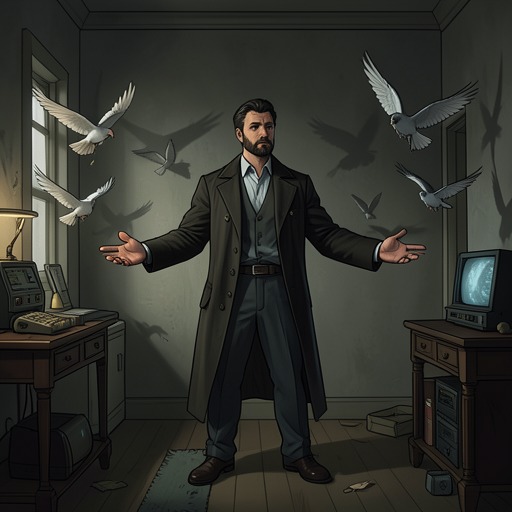
The Dark HalfThaddeus “Thad” Beaumont—Alan Pangborn relationship centers on a sharp reversal: Alan Pangborn first approaches Thad as a murder suspect, but his growing doubts about the evidence turn the interrogation into a request for assistance. Trust develops without becoming uncomplicated. Pangborn’s investigative caution keeps him at a distance, while the two men’s shared encounters with the case’s impossible dimension eventually place the sheriff amid the sparrows that have become bound to Thad’s struggle with George Stark.
First Encounter: The Sheriff and the Suspect
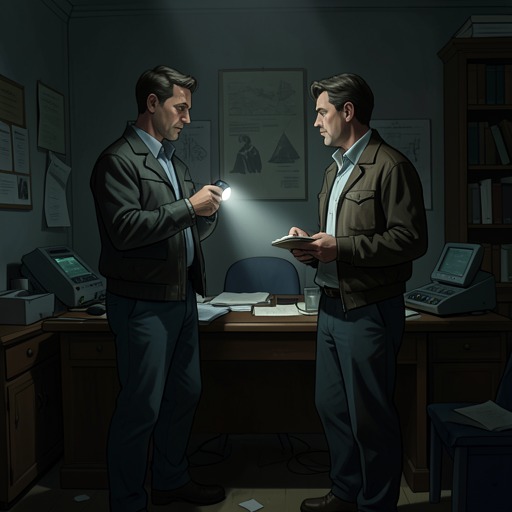
When Pangborn comes to the Beaumont home with two troopers, he identifies the visit as police business but does not initially explain its purpose. Thad’s ordinary curiosity gives way to sudden fear when Pangborn refuses his offered handshake. In Thad’s later account, that refusal makes him understand that the visitors believe he has done something; for an instant, he feels certain he will be powerless not to confess, though he has not yet been told what he is accused of.
Pangborn and the troopers then connect Thad to the murder of Homer Gamache. Thad’s bewildered response—that he does not know who Gamache is—does not settle the matter for the investigators. When he asks who killed Gamache, a trooper tells him that they have every reason to believe he did. The relationship is therefore established under direct suspicion, with Pangborn present as the official voice of a case that Thad cannot understand.
Suspicion Gives Way to a Request
Pangborn’s position is not simply adversarial. After hearing Thad, he tells him that every instinct in his body says Thad is telling the truth. He nevertheless remains troubled by the identification coming from Armed Services Records and Identification: he has never known the agency to make a mistake, and he warns that if its identification is correct and Thad’s account checks out, he too will be bewildered. His confidence in Thad’s apparent sincerity coexists with an unresolved evidentiary problem.
The stakes deepen when Pangborn reveals that Thad is suspected in a second murder, the killing of Frederick Clawson in Washington, D.C. Pangborn says that he does not understand how another person could have committed both crimes, but he is not there to arrest or harass Thad. He has come to ask for help. That change of purpose makes the relationship more collaborative, though not intimate: even while talking with Thad and Liz over drinks as the twins play nearby, Pangborn notes that he has no business socializing with a man who is a suspect in two murders. He also says the state police believe Thad has an alibi for the second killing and are quietly investigating in circles.
The Double-Twin Hypothesis
Thad responds to the gap in the case by constructing an elaborate explanation for how an identical twin could have divided the evidence. In his hypothetical, a twin hosts the party and keeps up appearances in Castle Rock while Thad drives Gamache’s truck, changes cars in Connecticut, travels to New York, and continues on to Washington to kill Clawson. The twin, Thad suggests, could then resume his ordinary life with Liz, or Liz could be included in the deception.
The account is deliberately framed as a challenge to Pangborn: Thad invites the sheriff to confess to having worked out the broad outline already. Liz laughs at the scenario, and Pangborn looks at Thad with open surprise. The twins briefly join their mother’s laughter before returning to their ball. In this exchange, Thad does not offer the twin theory as a confession or a proven explanation; he exposes how implausible the accusations look when their logistical demands are made explicit. The scene also gives Pangborn a view of Thad’s analytical response to suspicion rather than merely his denial of it.
Alliance Under Uncertainty
The movement from interrogation to cooperation does not erase Pangborn’s caution. He continues to address Thad formally, and when Thad invites him to use his first name, Pangborn says he would be more comfortable with “Mr. Beaumont” for the time being. His hesitation preserves the boundary between sheriff and suspect even as he asks Thad to help him make sense of the murders. Their alliance is practical and provisional, built around Pangborn’s belief that the case does not add up and Thad’s need to understand why he has been implicated.
Later, the danger confronting Thad becomes visible to Pangborn through the sparrows. At Gold’s Junkyard and Auto Supply, he and Rawlie DeLesseps find the dead vehicles across the back acreage covered in birds, gathered in overwhelming numbers without having announced their arrival. During the later approach to the lake house, a sparrow lands on Pangborn’s shoulder and then his hand; he lets it hop away, while the birds continue to fill the surrounding trees. He retreats to Lake Lane and observes that the flock seems to be holding back, as if the road were a staging area. The sheriff’s experience gives him direct contact with the phenomenon rather than leaving it as Thad’s private account.
Shared Danger and Narrative Significance
On the drive toward the house, Thad faces a flock that begins just ahead of his stopped car, so dense that the birds are the road. He recognizes that reaching the house means driving over them. The contrast between Thad’s forced passage and Pangborn’s cautious withdrawal along the lake road marks their different positions in the crisis: Thad must press toward his family and George Stark, while Pangborn encounters a boundary that appears to regulate how close the birds will come.
At the climax, Thad understands the sparrows as psychopomps—an escort for George Stark back to the land of the dead. The birds gather on Stark and overwhelm him as Thad retreats toward the children. Pangborn’s early role as the officer who doubts the evidence but cannot dismiss it thus leads into a larger pattern: he becomes a witness to the forces that make the case impossible to explain by ordinary investigation alone. The relationship’s defining tension remains intact to the end: Pangborn is neither simply an opponent nor a fully informed confidant, but a cautious lawman whose firsthand encounters bring him into Thad’s struggle.